
Introduction
Drying is one of the most critical processes in the pharmaceutical, chemical, food, and herbal industries. Choosing the right drying equipment directly affects product quality, production efficiency, and operating costs.
A Vacuum Tray Dryer (VTD) is specially designed to dry heat-sensitive and hygroscopic materials under vacuum at low temperatures. This ensures efficient moisture removal while preserving the physical and chemical properties of the product.
In this article, we’ll explain the complete working principle of a Vacuum Tray Dryer and why it is one of the most preferred drying systems across various industries.
What is a Vacuum Tray Dryer (VTD)?
A Vacuum Tray Dryer is a batch-type drying equipment that removes moisture from products under reduced pressure (vacuum). Since the boiling point of water and solvents decreases under vacuum, drying occurs at much lower temperatures compared to conventional dryers.
This makes VTD ideal for products that may degrade, oxidize, or lose quality when exposed to high temperatures.
Working Principle of a Vacuum Tray Dryer
The Vacuum Tray Dryer operates on a simple yet highly effective principle:
Lower Pressure = Lower Boiling Point = Faster Drying at Lower Temperature
By reducing the chamber pressure using a vacuum pump, moisture evaporates quickly without overheating the product.
Step-by-Step Working Process
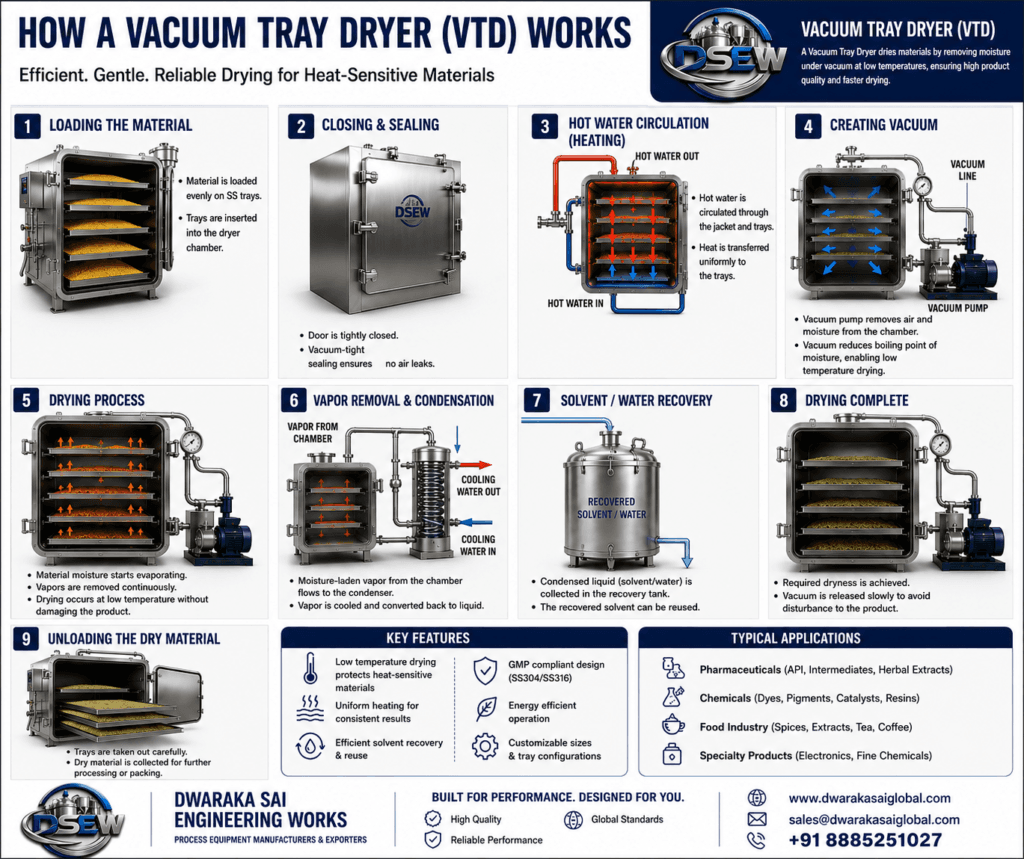
Step 1 – Material Loading
The wet material is uniformly spread on stainless steel trays and placed inside the drying chamber.
Proper tray loading ensures:
- Uniform heat transfer
- Consistent drying
- Improved product quality
Step 2 – Chamber Sealing
After loading, the chamber door is tightly closed using vacuum-tight sealing.
This prevents:
- Air leakage
- Vacuum loss
- Product contamination
Step 3 – Heating Process
Hot water or steam is circulated through the dryer jacket.
The heat is transferred from the jacket to the trays and then to the product.
This indirect heating method prevents direct exposure to flames or excessive temperatures.
Step 4 – Creating Vacuum
A vacuum pump removes air from the chamber.
As the pressure decreases:
- Water boils at a lower temperature.
- Solvents evaporate faster.
- Drying becomes energy efficient.
This is one of the biggest advantages of Vacuum Tray Dryers.
Step 5 – Drying Process
The supplied heat causes moisture inside the product to evaporate.
Because drying occurs under vacuum:
- Product colour is maintained.
- Active ingredients remain stable.
- Oxidation is minimized.
- Product quality improves.
Step 6 – Vapour Condensation
The moisture vapour leaves the drying chamber and enters the condenser.
Cooling water circulates through the condenser, converting the vapour back into liquid.
This prevents vapours from entering the vacuum pump.
Step 7 – Solvent Recovery
When organic solvents such as ethanol, IPA, methanol, or acetone are present, the condensed liquid is collected in a receiver tank.
Recovered solvent can often be reused after suitable treatment, reducing solvent consumption and operating costs.
Step 8 – Product Unloading
Once the required moisture level is achieved:
- Vacuum is released slowly.
- The chamber is opened.
- Trays are removed.
- The dried product is transferred for further processing or packaging.
Applications of Vacuum Tray Dryer
Vacuum Tray Dryers are widely used in:
- Pharmaceutical Industry
- Chemical Industry
- Food Processing
- Herbal Extracts
- Nutraceuticals
- Fine Chemicals
- Dyes & Pigments
- Specialty Chemicals
Advantages of Vacuum Tray Dryer
✔ Low-temperature drying
✔ Uniform heat distribution
✔ Excellent product quality
✔ Suitable for heat-sensitive materials
✔ Suitable for hygroscopic materials
✔ Reduced oxidation
✔ Solvent recovery option
✔ Energy-efficient operation
✔ GMP-compliant design
✔ Easy operation and maintenance
Why Choose Dwaraka Sai Engineering Works?
At Dwaraka Sai Engineering Works, we manufacture high-quality Vacuum Tray Dryers designed for reliable performance, long service life, and GMP compliance.
Our VTDs are available in various capacities and can be customized according to customer process requirements.
We focus on:
- Premium stainless steel construction
- Robust engineering
- Uniform heating performance
- Vacuum-tight design
- Reliable after-sales support
Frequently Asked Questions (FAQs)
What is a Vacuum Tray Dryer used for?
It is used for drying heat-sensitive pharmaceutical, chemical, food, and herbal products under vacuum.
Why is vacuum used during drying?
Vacuum lowers the boiling point of moisture, allowing drying at lower temperatures while protecting product quality.
Can a Vacuum Tray Dryer recover solvents?
Yes. When used with a condenser and receiver, solvents such as ethanol or IPA can be recovered and reused.
Which heating medium is used in a VTD?
Most Vacuum Tray Dryers use hot water or steam circulating through the jacket.
Which industries use Vacuum Tray Dryers?
Pharmaceutical, chemical, food, herbal, nutraceutical, and specialty chemical industries commonly use VTDs.
Looking for a Reliable Vacuum Tray Dryer?
If you’re looking for a high-quality, GMP-compliant Vacuum Tray Dryer for your application, our team is here to help.
Dwaraka Sai Engineering Works
🌐 www.dwarakasaiglobal.com
📧 sales@dwarakasaiglobal.com
📞 +91 8885251027