
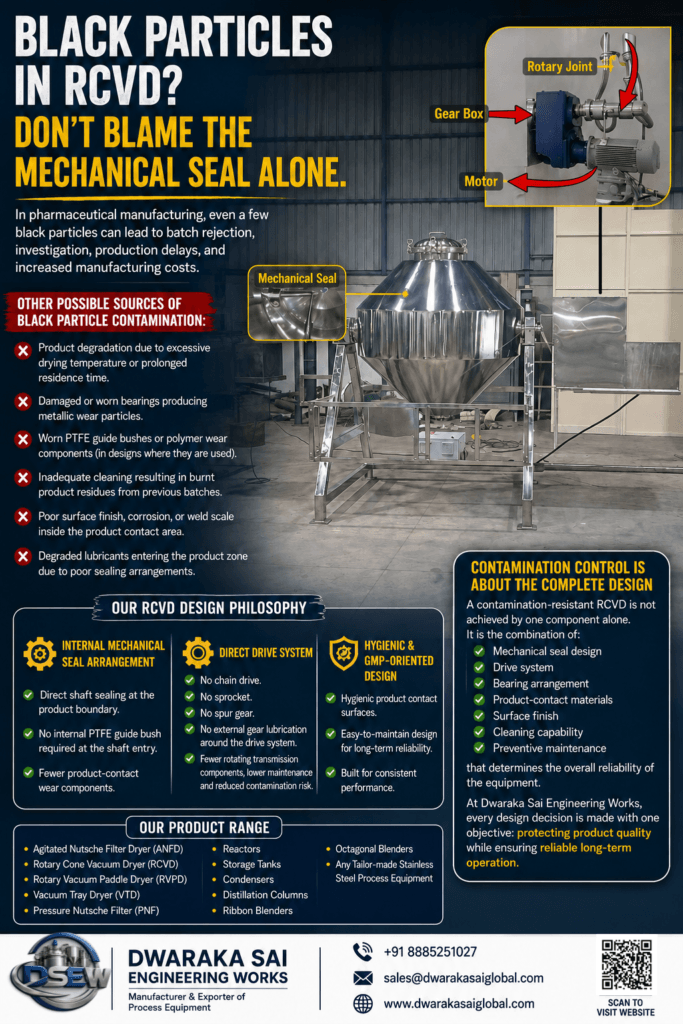
Black Particle Contamination in RotoCone Vacuum Dryers (RCVD)
In pharmaceutical manufacturing, product quality is non-negotiable. Even a few black particles detected during production can result in batch rejection, lengthy investigations, production delays, regulatory concerns, and significant financial losses.
When black particle contamination is found in a Rotary Cone Vacuum Dryer (RCVD), the mechanical seal is often blamed immediately. While mechanical seal wear can certainly contribute to contamination, it is only one of several possible causes.
A contamination-free RCVD depends on the overall machine design, proper maintenance, high-quality components, and good manufacturing practices—not just a single sealing component.
Why Black Particles Appear in an RCVD
Black particles may originate from several different sources inside or around the equipment. Identifying the actual cause is essential before replacing components or modifying the machine.
1. Product Degradation
Some pharmaceutical products become dark or carbonize when exposed to:
- Excessive drying temperatures
- Longer-than-required drying cycles
- Localized overheating
These degraded product particles are often mistaken for mechanical contamination.
2. Mechanical Seal Wear
Mechanical seals experience continuous rotation under vacuum conditions.
If:
- maintenance intervals are ignored,
- seal faces become worn,
- installation is incorrect, or
- alignment is poor,
small wear particles may eventually appear inside the product zone.
Proper seal selection and preventive maintenance significantly reduce this risk.
3. Bearing Wear
Bearings supporting rotating assemblies gradually wear over time.
Damaged bearings may produce:
- metallic particles
- fine black wear dust
- increased vibration
Ignoring abnormal vibration can eventually lead to contamination as well as mechanical failure.
4. PTFE Guide Bush Wear
Many conventional RCVD designs use an internal PTFE guide bush near the shaft entry.
Over extended operation, this guide bush may:
- wear due to friction
- generate PTFE particles
- require periodic replacement
Although PTFE itself is not black, wear combined with process residues may appear as dark contamination.
5. Residue from Previous Batches
Improper cleaning is one of the most common contamination sources.
Residue remaining after a previous batch can:
- dry inside the cone
- carbonize during heating
- break loose during the next batch
This contamination is often completely unrelated to the mechanical seal.
6. Surface Corrosion or Poor Internal Finish
Poor fabrication practices can introduce contamination through:
- weld scale
- corrosion
- rough surface finish
- incomplete passivation
These imperfections can trap product and create recurring contamination issues.
7. Lubricant Ingress
If lubrication from the drive system reaches the product zone, contamination may occur.
Possible causes include:
- damaged seals
- poor isolation between the drive assembly and product chamber
- excessive lubrication
- incorrect maintenance
Proper isolation between mechanical components and the product area is essential.
Why RCVD Design Matters
Preventing contamination begins during the equipment design stage.
A well-designed RCVD minimizes unnecessary wear components and isolates moving mechanical parts from the product contact area.
At Dwaraka Sai Engineering Works, contamination control is considered throughout the entire machine—not just at the seal.
How Our RCVD Design Helps Minimize Contamination
Internal Mechanical Seal Arrangement
Our RCVD uses an internal mechanical seal arrangement where the shaft is sealed directly at the product boundary.
Advantages
- Direct shaft sealing
- No internal PTFE guide bush required
- Fewer wear components in product contact
- Simplified hygienic sealing arrangement
- Reduced maintenance
This design minimizes potential wear sources while maintaining reliable sealing performance.
Direct Drive Technology
Unlike conventional RCVDs that rely on:
- chain drives
- sprockets
- spur gears
our equipment uses a Direct Drive System.
Benefits include:
- No chain wear
- No sprocket wear
- No spur gear wear
- No external transmission lubrication near the product zone
- Lower maintenance
- Smooth and efficient power transmission
- Reduced wear components
- Improved contamination control
Fewer mechanical transmission components mean fewer opportunities for wear particle generation.
Completely Isolated Drive System
Our drive system is designed to remain isolated from the product contact area.
This helps minimize:
- lubricant ingress
- wear particle migration
- external contamination entering the process chamber
Proper isolation supports long-term product integrity and cleaner pharmaceutical processing.
GMP-Oriented Construction
Our RCVD is designed according to pharmaceutical equipment manufacturing practices.
Standard features include:
- SS316L product contact parts
- Smooth internal surface finish
- Easy-to-clean construction
- Hygienic design
- Reliable pharmaceutical operation
These features simplify cleaning validation and help maintain consistent product quality.
Contamination Control Requires a Complete Engineering Approach
Focusing only on the mechanical seal overlooks many other potential contamination sources.
A contamination-resistant RCVD requires the right combination of:
- Mechanical seal arrangement
- Drive system design
- Bearing selection
- Product-contact materials
- Internal surface finish
- Effective cleaning capability
- Preventive maintenance program
- Proper operating procedures
Every component contributes to maintaining pharmaceutical product quality.
Best Practices to Reduce Black Particle Contamination
To minimize contamination risks:
- Follow preventive maintenance schedules.
- Inspect bearings and seals regularly.
- Validate cleaning after every batch.
- Avoid excessive drying temperatures.
- Maintain proper alignment of rotating components.
- Inspect internal surfaces for corrosion or damage.
- Replace worn components before failure occurs.
- Use GMP-compliant equipment designed for pharmaceutical applications.
Why Choose Dwaraka Sai Engineering Works?
At Dwaraka Sai Engineering Works, we believe contamination prevention starts with intelligent engineering.
Our RCVDs are designed to:
- Reduce unnecessary wear components
- Eliminate internal PTFE guide bushes through our sealing arrangement
- Utilize Direct Drive technology for smoother operation
- Isolate the drive system from the product contact area
- Simplify maintenance
- Support GMP-oriented pharmaceutical manufacturing
- Help manufacturers achieve reliable, contamination-controlled drying operations
Our engineering philosophy is simple:
Eliminate unnecessary wear components. Isolate the drive system. Design every detail to support cleaner, safer pharmaceutical manufacturing.
Frequently Asked Questions (FAQs)
Is the mechanical seal always responsible for black particle contamination?
No. Black particles may also originate from product degradation, bearing wear, cleaning issues, lubricant ingress, PTFE guide bush wear (in conventional designs), corrosion, or poor surface finish.
Does Direct Drive reduce contamination?
Yes. Direct Drive eliminates chains, sprockets, and spur gears, reducing wear components and minimizing the possibility of contamination from external transmission systems.
Why is drive isolation important?
A properly isolated drive system helps prevent lubricants and mechanical wear particles from entering the product contact area.
How often should RCVD components be inspected?
Inspection frequency depends on operating hours, product characteristics, and maintenance schedules. Regular preventive maintenance is recommended to identify wear before contamination occurs.
Which material is recommended for pharmaceutical RCVD product contact parts?
SS316L is widely preferred because of its corrosion resistance, cleanability, and suitability for pharmaceutical applications.
Conclusion
Black particle contamination is rarely caused by a single component. It is the result of multiple engineering, operational, and maintenance factors working together.
Choosing an RCVD with an optimized sealing arrangement, Direct Drive technology, proper drive isolation, GMP-oriented construction, and a robust preventive maintenance program can significantly reduce contamination risks and improve long-term process reliability.
At Dwaraka Sai Engineering Works, every RCVD is engineered with product quality, equipment reliability, and contamination control at the forefront.
Looking for a contamination-resistant Rotary Cone Vacuum Dryer for pharmaceutical manufacturing? Contact Dwaraka Sai Engineering Works to discuss your process requirements and discover how our engineered solutions can support cleaner, more reliable production.