
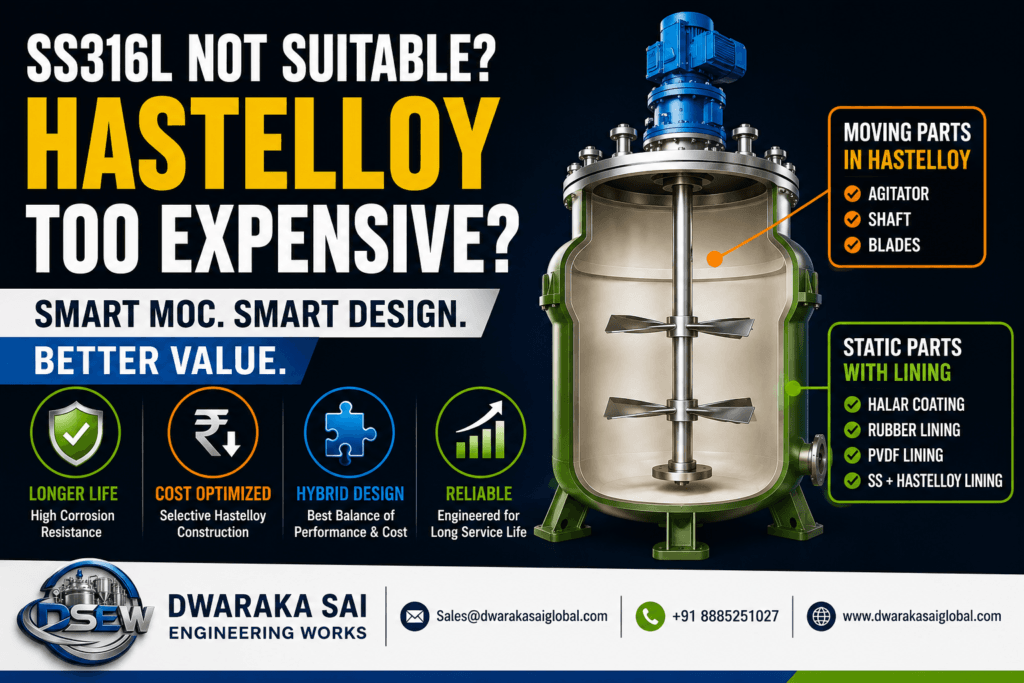
When SS316L is not suitable for a highly corrosive process, Hastelloy is often considered as the next material option.
But does the complete process equipment always need to be manufactured from Hastelloy?
Not necessarily.
Depending on the process chemistry and operating conditions, a carefully engineered combination of Hastelloy components and suitable lining/coating systems can sometimes provide a practical balance between corrosion resistance, equipment reliability, service life and overall investment cost.
Understanding Material of Construction Selection
Material of Construction (MOC) selection should not be based only on the fact that a process is highly acidic or corrosive.
The actual process conditions need to be evaluated, including:
- Chemical composition
- Chemical concentration
- Operating temperature
- Chloride concentration
- Oxidizing or reducing conditions
- Contact/residence time
- Mechanical action
- Cleaning and CIP conditions
- Pressure or vacuum conditions
- Required equipment service life
Once these parameters are understood, the appropriate material strategy can be evaluated.
When SS316L Is Not Suitable
In aggressive chemical environments, SS316L may not provide the required corrosion resistance or service life.
In such cases, engineers may evaluate options such as:
- Hastelloy
- Halar coating
- Rubber lining
- PVDF / fluoropolymer lining
- SS with Hastelloy lining
- Other application-specific corrosion-resistant materials
The selection depends entirely on the actual process conditions.
Does the Entire Equipment Need to Be Hastelloy?
This is where hybrid MOC design can become an interesting engineering approach.
In equipment containing moving product-contact components, parts such as:
Agitator / Stirrer → Hastelloy
Shaft → Hastelloy
Blades → Hastelloy
These components are continuously exposed to mechanical movement, product contact, abrasion and repeated cleaning.
Therefore, depending on the application, using Hastelloy for these critical moving components can provide better resistance and durability.
At the same time, suitable static product-contact surfaces may be evaluated for protection using:
- Halar coating
- Rubber lining
- PVDF / fluoropolymer lining
- SS + Hastelloy lining
This approach can potentially avoid making the complete equipment from Hastelloy when it is not technically necessary.
Why Can Hybrid MOC Design Be Beneficial?
A properly engineered hybrid construction may provide several advantages.
1. Optimized Equipment Cost
Using Hastelloy selectively rather than throughout the entire equipment can potentially reduce the overall material cost.
2. Protection of Critical Components
The components experiencing continuous movement and mechanical stress can be manufactured from a more corrosion-resistant alloy.
3. Better Service Life
Properly selecting the MOC for each component can help improve equipment reliability and service life.
4. Reduced Lining Risk on Moving Components
Lining and coating systems can be very useful for suitable static surfaces. However, moving components experience additional mechanical forces, abrasion and repeated movement.
For this reason, the suitability of a lining or coating should always be evaluated carefully before using it on moving parts.
Hastelloy Is Still the Right Choice in Many Applications
Hybrid construction does not mean that Hastelloy should be avoided.
There are applications where the process conditions are sufficiently severe that Hastelloy or another high-performance alloy may be the technically appropriate choice for major equipment components or even the complete equipment.
The objective is not to choose the cheapest material.
The objective is to choose the right material for the right application.
The Importance of Process-Specific MOC Selection
There is no universal rule such as:
“Highly acidic process = Hastelloy.”
Similarly, there is no universal rule that a lining or coating will always be an economical replacement for a solid alloy.
Every application should be evaluated based on its actual operating conditions.
A technically sound MOC strategy considers:
Chemistry + Concentration + Temperature + Chlorides + Mechanical Action + Cleaning + Required Service Life
before the final equipment construction is selected.
Conclusion
When SS316L is not suitable and a complete Hastelloy equipment becomes a high-investment option, hybrid MOC construction can be considered as one possible engineering approach.
For example, critical moving components such as the agitator, shaft and blades can be manufactured from Hastelloy, while suitable static surfaces can be evaluated for Halar coating, rubber lining, PVDF/fluoropolymer lining or SS + Hastelloy lining, depending on the process.
The final selection must always be based on process compatibility and engineering evaluation.
The smartest equipment is not always 100% Hastelloy.
Sometimes, selective Hastelloy construction combined with a suitable lining or coating system can provide a better balance between performance, reliability and investment cost.
At Dwaraka Sai Engineering Works, we believe that MOC selection should begin with understanding the actual process conditions, rather than simply selecting the highest available material grade.