
When developing a new pharmaceutical, chemical or specialty product, process development does not begin at full production scale.
Before moving to a large production vessel, engineers often need to understand how the product behaves during filtration, washing and drying.
This is where a Kilo Lab, R&D or compact Agitated Nutsche Filter Dryer (ANFD) can become an important process-development tool.
Why Use an ANFD at R&D Scale?
An ANFD combines multiple operations in a single closed vessel:
- Filtration
- Cake washing
- Cake re-slurrying, where required
- Vacuum drying
- Agitation during drying
Using the same basic process principle at a smaller scale can help engineers evaluate important process parameters before scaling up to production equipment.
The objective is not simply to manufacture a smaller vessel.
The objective is to understand the process at a controlled scale and generate useful information for scale-up.
What Can Be Studied at Kilo Lab or R&D Scale?
A compact ANFD can help evaluate several aspects of the process.
1. Filtration Behaviour
Different products can behave very differently during filtration.
Cake permeability, filtration rate, cake thickness and resistance to liquid flow can influence the design of the filtration system.
Testing with an R&D-scale ANFD can provide useful information about the filtration behaviour of the product.
2. Filter Media Selection
Filter media selection can have a significant effect on filtration performance.
Depending on the application, an ANFD may be designed with different filtration arrangements.
Two commonly considered options are:
Sintered Mesh
Sintered metal filter elements can provide a rigid, reusable filtration surface and may be suitable for applications requiring mechanical robustness and repeated cleaning.
PP Filter Cloth
Polypropylene filter cloth can be considered where a flexible filter medium is more appropriate for the process and product characteristics.
Providing flexibility in filter-media selection can be particularly useful during process development.
Why Is Washing Important?
In many processes, filtration is not the final operation.
The filtered cake may need to be washed to remove mother liquor, impurities or residual soluble components.
An ANFD allows filtration and washing to be performed within the same enclosed vessel.
This can reduce unnecessary product transfer and help maintain a controlled process environment.
For R&D work, washing parameters such as solvent quantity, washing method and mixing conditions can also be evaluated before production-scale implementation.
The Role of the Hollow Shaft and Hollow Agitator
Drying performance depends not only on the jacket around the vessel.
The internal heating arrangement can also be important.
A hollow shaft and hollow agitator can provide additional heated surfaces in contact with or close to the product.
During vacuum drying, these additional heat-transfer surfaces can support efficient transfer of heat to the product.
Agitation can also help expose different portions of the cake to the available heated surfaces and assist in breaking up and redistributing the material during drying.
The exact arrangement, however, should always be selected according to the product characteristics and process requirements.
Why Jacket the Shell and Bottom?
The vessel shell and bottom are major heat-transfer surfaces in an ANFD.
Providing a jacketed shell and jacketed bottom allows heating to be applied through these surfaces.
Combined with an appropriate agitator arrangement, this can provide a more effective heating configuration for vacuum drying.
For process development, the heating arrangement is particularly important because drying time, product temperature and heat-transfer behaviour can influence the final production-scale design.
Filtration, Washing and Drying in One Closed Vessel
One of the major advantages of an ANFD is the ability to perform multiple operations within the same vessel.
A typical process sequence may involve:
Filtration → Washing → Filtration → Vacuum Drying
Depending on the process, agitation can be used during washing, re-slurrying or drying.
Keeping these operations within a closed vessel can reduce product handling and intermediate transfer.
This can be particularly valuable for pharmaceutical and specialty chemical applications where containment and controlled processing are important.
Why 100 Liters Can Be Useful for Process Development
A 100-liter ANFD occupies an interesting position between laboratory experimentation and larger production equipment.
It can provide a larger process-development platform while remaining significantly smaller than many production-scale systems.
The actual suitability of a 100-liter unit depends on the product, batch size, required cake thickness, filtration area, drying requirements and other process parameters.
Therefore, capacity should not be selected in isolation.
Scale-Up Is More Than Simply Increasing Vessel Size
One common misconception is that scaling up an ANFD simply means increasing the vessel volume.
In reality, several parameters need to be considered.
These may include:
- Filtration area
- Cake thickness
- Filter-media characteristics
- Agitator design
- Agitation speed
- Heat-transfer area
- Product temperature
- Vacuum conditions
- Drying time
- Washing requirements
- Product behaviour during agitation
Information obtained during R&D or pilot-scale testing can help engineers make better decisions when designing the larger production unit.
From Kilo Lab to Production Scale
A well-designed R&D ANFD can therefore become more than just a small piece of equipment.
It can be part of the process-development and scale-up strategy.
The same fundamental operations—filtration, washing and vacuum drying—can be evaluated at a smaller scale before moving toward larger production equipment.
This is why ANFD design should be considered around the process requirements, rather than capacity alone.
Our Approach
At Dwaraka Sai Engineering Works, we manufacture Agitated Nutsche Filter Dryers across different process scales, including compact equipment for Kilo Lab, R&D and process-development applications, as well as larger production-scale equipment.
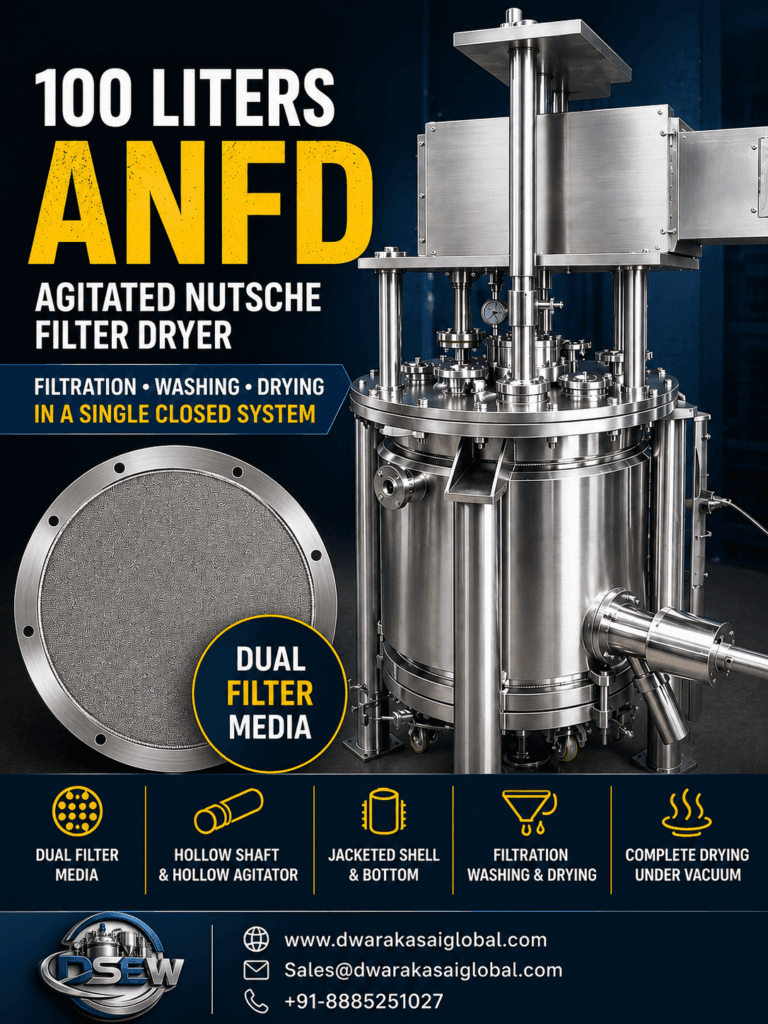
Our 100-liter ANFD configuration demonstrates our ability to engineer compact systems with features such as:
- Dual provision for Sintered Mesh / PP Filter Cloth
- Hollow shaft and hollow agitator
- Jacketed shell
- Jacketed bottom
- Filtration, washing and vacuum drying capability
The objective is simple:
Engineer the equipment around the process—not simply around the capacity.
From Kilo Lab and R&D scale to larger production systems, the right equipment design can help create a smoother path from process development to manufacturing.
Dwaraka Sai Engineering Works
Process Equipment | Filtration | Drying | Custom Engineering
🌐 www.dwarakasaiglobal.com
📧 Sales@dwarakasaiglobal.com
📞 +91 8885251027
#ANFD #AgitatedNutscheFilterDryer #KiloLab #RAndD #ProcessDevelopment #ScaleUp #PharmaceuticalEngineering #ProcessEquipment #Filtration #VacuumDrying #MadeInIndia