
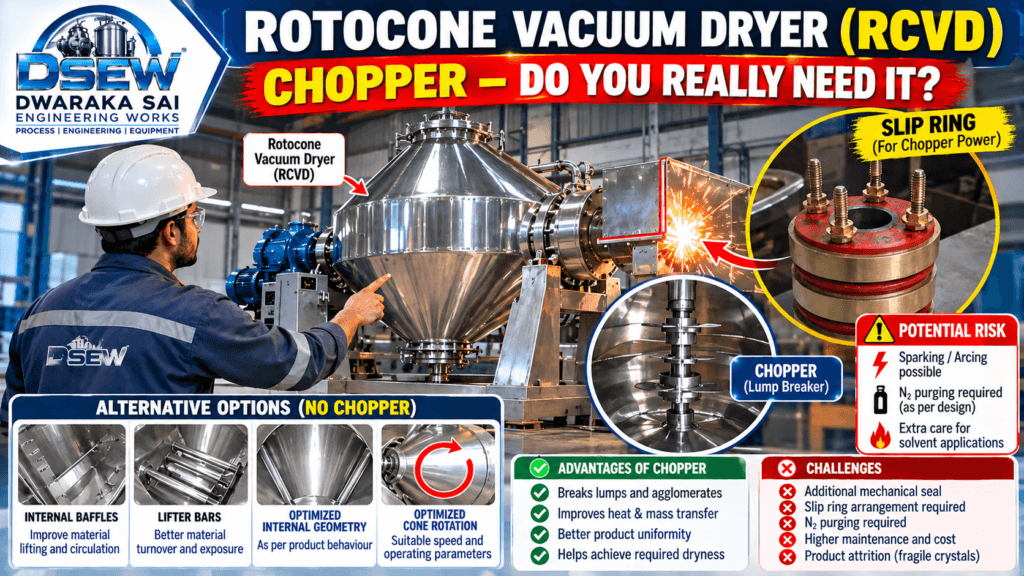
The Rotocone Vacuum Dryer (RCVD) is widely used for vacuum drying of pharmaceutical, API, chemical and specialty chemical products. Depending on the product characteristics, an RCVD may be equipped with a chopper or lump breaker to break agglomerates formed during the drying process.
But an important engineering question is:
Is a chopper really necessary for every RCVD application?
The answer depends on the product behaviour, agglomeration tendency and drying requirements.
What is the Function of a Chopper in RCVD?
A chopper is an internal rotating device used to break lumps and agglomerates during the drying cycle.
During vacuum drying, some products can become cohesive as moisture or solvent is removed. Large agglomerates may form, which can reduce effective surface exposure and affect drying performance.
A properly selected chopper can help break these agglomerates and improve material movement.
Advantages of Chopper in RCVD
1. Lump and Agglomerate Breaking
The primary function of the chopper is to break larger lumps formed during the drying process.
This is particularly useful for products that become cohesive during drying.
2. Improved Material Exposure
Breaking larger agglomerates exposes fresh product surfaces to the heated vessel surface and the vacuum environment.
This can contribute to improved drying behaviour.
3. Better Product Uniformity
For suitable applications, reducing large agglomerates can help achieve a more uniform final product.
4. Improved Heat and Mass Transfer
Deagglomeration can increase the effective surface area exposed to the drying environment, potentially improving heat and mass transfer.
Challenges Associated with Chopper
Although a chopper can provide significant process benefits, it also introduces additional mechanical and electrical considerations.
1. Additional Mechanical Seal
The chopper shaft requires a suitable sealing arrangement to maintain the vacuum integrity of the RCVD.
The mechanical seal therefore becomes an additional component requiring inspection and maintenance.
2. Slip-Ring Arrangement
Depending on the chopper configuration, electrical power transfer to the rotating chopper assembly may require a slip-ring arrangement.
Slip rings contain electrical contact surfaces that require proper maintenance and protection.
3. Sparking / Arcing Considerations
A slip-ring assembly can present a potential source of sparking or arcing, particularly in situations involving wear, contamination or poor electrical contact.
This becomes an important engineering consideration when the RCVD is handling solvent-based processes.
4. Nitrogen Purging
Where required by the equipment design and process safety philosophy, the slip-ring enclosure may require controlled Nitrogen (N₂) purging.
The purge arrangement may incorporate appropriate monitoring, timer logic and/or interlocks depending on the application and design requirements.
5. Solvent Applications
When flammable solvent vapours are present, the electrical and mechanical arrangements associated with the chopper require additional attention.
The design should consider appropriate protection, sealing, purging and applicable hazardous-area requirements.
6. Additional Maintenance
A chopper adds components such as:
- Chopper drive
- Shaft
- Mechanical seal
- Bearings
- Slip-ring assembly
- Associated electrical components
Therefore, maintenance requirements are higher compared with a simpler RCVD configuration.
7. Product Attrition
For fragile crystals or shear-sensitive products, excessive chopping can generate fines or affect the desired particle morphology.
The chopper speed, blade design and operating conditions should therefore be selected according to the product.
Can a Chopper Be Avoided?
Yes—where aggressive mechanical deagglomeration is not essential, the RCVD can be designed with optimized internal arrangements.
Possible approaches include:
Internal Baffles
Internal baffles can improve material lifting, tumbling and circulation as the cone rotates.
Lifter Bars
Lifter bars can help lift and redistribute the product, improving material turnover and exposure to the heated surfaces.
Optimized Internal Geometry
The internal geometry can be designed according to the product’s flow characteristics and tendency to agglomerate.
Optimized Cone Rotation
Suitable cone rotation speed and operating parameters can improve material movement and tumbling.
However, these arrangements should not be considered a direct replacement for a chopper when aggressive lump breaking is an essential process requirement.
How Should the Chopper Requirement Be Decided?
The chopper should not be added simply because it is commonly used in RCVDs.
The decision should consider:
- Product characteristics
- Agglomeration tendency
- Initial and final moisture content
- Solvent properties
- Required particle size
- Product sensitivity
- Drying behaviour
- Heat and mass transfer requirements
- Vacuum integrity
- Cleaning requirements
- Electrical and safety considerations
Engineering Principle
The objective is not to add more components. The objective is to achieve the required drying performance with the simplest and safest suitable RCVD configuration.
At Dwaraka Sai Engineering Works, Rotocone Vacuum Dryer configurations can be customized according to specific product and process requirements.
Dwaraka Sai Engineering Works
Process Engineering | Equipment | Customized Solutions
🌐 dwarakasaiglobal.com
📩 sales@dwarakasaiglobal.com