
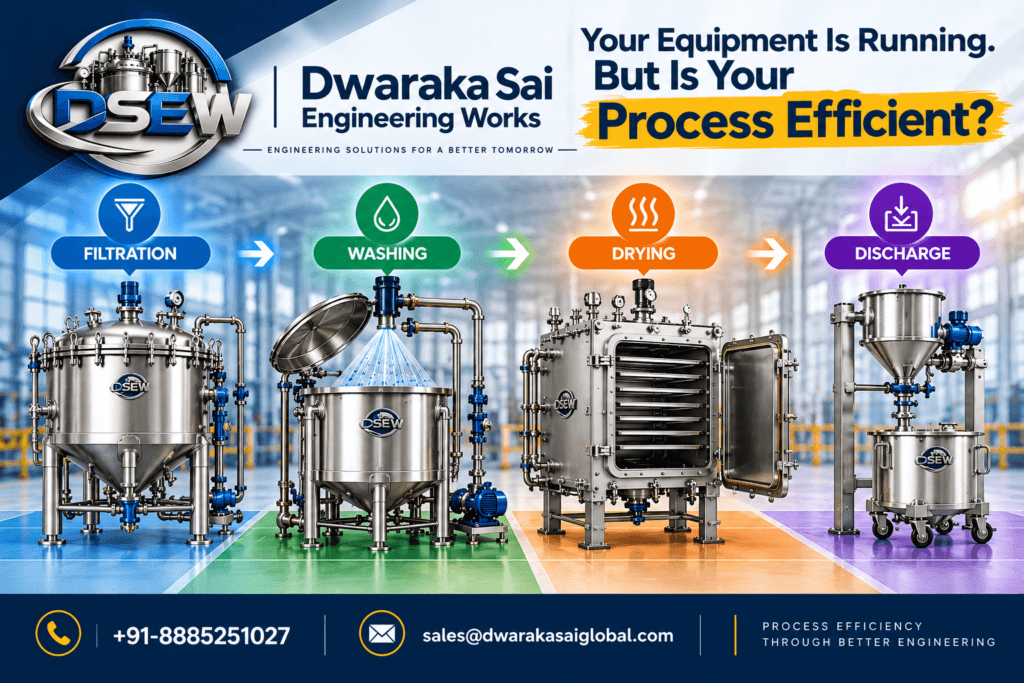
In pharmaceutical and chemical manufacturing, production efficiency depends on much more than the reliability of individual equipment. Filtration time, cake washing performance, drying efficiency, product quality, and cleaning requirements all influence the overall batch cycle.
A process may operate without equipment failure and still experience unnecessary delays, excessive solvent consumption, or reduced production capacity.
The key to improving productivity is identifying the actual process bottlenecks and addressing them through a systematic engineering approach.
At Dwaraka Sai Engineering Works, we recognise the importance of understanding process requirements when evaluating industrial process equipment and potential opportunities for improvement.
In this article, we explore five common process bottlenecks that can affect pharmaceutical and chemical manufacturing operations.
1. Long Filtration Cycles: Understanding the Bottleneck
Filtration is a critical operation in many pharmaceutical and chemical processes. When solid-liquid separation takes longer than expected, it can delay subsequent processing steps and reduce equipment availability.
Several factors can influence filtration performance, including:
- Particle size distribution and slurry characteristics
- Filter media selection and compatibility
- Filter area and cake thickness
- Cake permeability and resistance to liquid flow
- Operating pressure differential and process conditions
For example, a slurry that forms a highly resistant filter cake may require significantly more time for liquid removal than a slurry with better permeability.
Engineering approach: Review the slurry characteristics, filtration requirements, filter media, available filtration area, and operating parameters. The objective is to identify the cause of slow filtration rather than simply increasing operating pressure or extending the cycle time.
2. High Solvent Consumption: Optimising Cake Washing
Cake washing is often required to remove residual mother liquor and soluble impurities from filtered solids.
However, increasing the washing solvent quantity does not automatically guarantee better washing performance. The result depends on the cake structure, solvent distribution, washing technique, and the nature of the impurities being removed.
Inefficient washing can contribute to:
- Higher solvent consumption
- Increased solvent recovery requirements
- Additional downstream processing
- Longer batch processing time
- Greater operating costs
Engineering approach: Evaluate the washing strategy, solvent-to-cake ratio, cake thickness, and washing distribution. The goal is to achieve the required impurity removal and product quality while avoiding unnecessary solvent consumption.
Any process changes should be assessed against product specifications and applicable validation requirements.
3. Inconsistent Product Quality: Controlling Process Variability
Consistent product quality is essential in pharmaceutical manufacturing. Even when the same equipment is used for every batch, variations in raw materials and operating conditions can influence the final result.
Potential contributing factors include:
- Variations in slurry composition
- Inconsistent cake formation
- Differences in washing effectiveness
- Variable drying conditions
- Inadequate monitoring of critical process parameters
These variations may result in additional testing, investigations, reprocessing, or batch delays, depending on the circumstances.
Engineering approach: Identify critical process parameters and evaluate batch-to-batch performance. Appropriate monitoring, documented operating procedures, and effective process controls help improve consistency and support reliable manufacturing.
4. Extended Drying Time: Improving Overall Batch Performance
Drying can become a major bottleneck when the product takes longer than expected to achieve the required moisture content or residual solvent level.
Drying performance depends on several factors, including:
- Product characteristics and initial moisture content
- Cake thickness and product-bed uniformity
- Heat-transfer efficiency
- Vacuum conditions and system performance
- Agitation and product movement, where applicable
- Product temperature limitations
Long drying cycles can restrict equipment availability and reduce the number of batches that can be processed within a given period.
Engineering approach: Evaluate heat transfer, vacuum performance, product-bed characteristics, and the suitability of the drying method for the material being processed. Improvements should be made within established product quality, safety, and validated process limits.
The appropriate solution depends on the product and the specific process requirements; a single approach will not suit every application.
5. Frequent Cleaning and Changeovers: The Hidden Cost of Downtime
Production efficiency is not determined by processing time alone. Cleaning, inspection, equipment preparation, and product changeovers also contribute to the overall production schedule.
Equipment design can influence how easily product-contact surfaces are accessed, how effectively residues can be removed, and how much time is required to prepare equipment for the next batch.
Potential challenges include:
- Difficult-to-access product-contact areas
- Inadequate drainability
- Residue accumulation in unsuitable locations
- Complex cleaning procedures
- Extended equipment preparation between batches
Engineering approach: Review equipment accessibility, product-contact geometry, drainability, cleaning procedures, and changeover requirements. Equipment modifications should be evaluated for compatibility with cleaning validation, process safety, and applicable regulatory requirements.
A Systematic Approach to Process Efficiency
Before investing in additional equipment or increasing installed capacity, manufacturers should analyse the complete batch cycle.
A structured process review can help answer five important questions:
- Which operation consumes the greatest amount of time?
- Is the bottleneck caused by equipment limitations, product characteristics, or operating parameters?
- Can unnecessary material transfers or handling steps be reduced?
- Are filtration, washing, and drying operations properly coordinated?
- Could process optimisation or equipment modification address the problem?
Actual operating data, batch records, and process requirements should guide improvement decisions. Assumptions alone are not sufficient to identify the correct solution.
Conclusion: Better Process Engineering Can Improve Productivity
Improving pharmaceutical manufacturing efficiency requires a complete understanding of the process, not just the equipment.
Long filtration cycles, excessive solvent consumption, inconsistent product quality, extended drying time, and frequent cleaning requirements can all affect production performance. Identifying the underlying causes is the first step towards meaningful improvement.
Sometimes, improving productivity does not require a bigger machine. It requires identifying the right bottleneck and developing a better-engineered process.
Dwaraka Sai Engineering Works focuses on industrial process equipment and engineering solutions for pharmaceutical and chemical manufacturing applications.
For equipment-related enquiries and process discussions, contact our team.
Dwaraka Sai Engineering Works
Engineering Solutions for a Better Tomorrow.
Website: https://www.dwarakasaiglobal.com
Email: sales@dwarakasaiglobal.com