
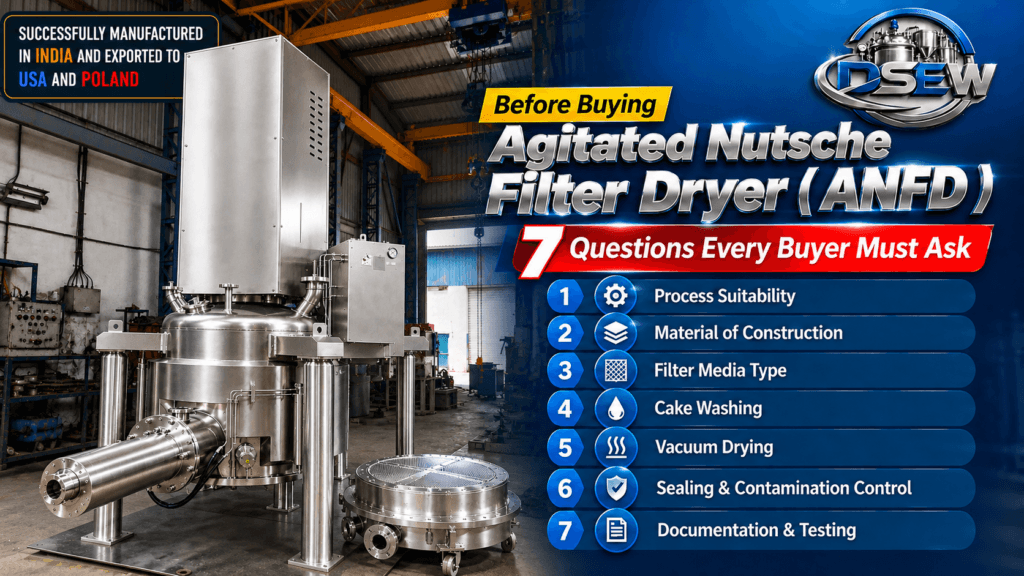
Choosing the right Agitated Nutsche Filter Dryer (ANFD) is an important decision for pharmaceutical, API and chemical manufacturing companies. An ANFD can combine filtration, cake washing and vacuum drying in a single closed system, depending on the equipment configuration and process requirements.
However, selecting the right equipment involves more than comparing quotations. Buyers should evaluate process suitability, material compatibility, filtration performance, drying requirements, sealing arrangements and documentation before finalizing a manufacturer.
In this guide, we explain seven important questions to ask your ANFD supplier before purchasing the equipment.
1. Is the ANFD Suitable for Your Process?
Every product has different physical and chemical characteristics. Slurry properties, particle size, solid concentration, cake behaviour and solvent characteristics can influence equipment selection.
Before ordering an ANFD, discuss the following with your supplier:
- Product and slurry characteristics
- Required filtration capacity and cycle time
- Cake thickness and cake discharge requirements
- Washing procedure and solvent compatibility
- Drying temperature, vacuum level and final moisture requirements
A properly evaluated design helps ensure that the equipment meets the intended process requirements.
2. What Is the Material of Construction (MOC)?
Material selection is critical when handling corrosive chemicals, pharmaceutical intermediates and active pharmaceutical ingredients.
Common construction materials include SS304, SS316L and corrosion-resistant alloys such as Hastelloy C22, depending on the application.
Ask your supplier to confirm:
- Compatibility with the product and process chemicals
- Material requirements for all product-contact parts
- Suitability of seals, gaskets and filter media
- Required surface finish and cleaning procedures
- Availability of material test certificates, where specified
The correct material should be selected based on chemical compatibility, operating conditions and applicable process requirements—not price alone.
3. Which Filter Media Is Required?
Filter media directly affects filtration performance, filtrate clarity and product recovery.
Depending on the process, an ANFD may use suitable filter cloth or sintered metal filter media.
Consider these factors when selecting filter media:
- Particle size and particle-size distribution
- Required filtrate clarity
- Cake formation and filtration rate
- Chemical and temperature compatibility
- Cleaning, replacement and maintenance requirements
Your supplier should evaluate the application before recommending the filter media.
4. How Will Uniform Cake Washing Be Achieved?
Cake washing is important when the process requires removal of residual mother liquor, impurities or unwanted soluble components.
Ask the manufacturer how the proposed ANFD design will support your washing procedure. Discuss agitator operation, cake resuspension requirements, washing-liquid distribution and the number of washing stages.
The optimum approach depends on product properties, cake permeability and the required purity of the final product. Washing performance should be assessed against the process requirements.
5. How Is Vacuum Drying Achieved?
An ANFD can facilitate drying after filtration and washing by combining vacuum with a suitable heating arrangement.
Before purchasing, clarify:
- Heating jacket configuration and heating medium
- Whether a heated agitator is required
- Operating temperature and vacuum requirements
- Solvent vapour handling and condenser requirements
- Expected drying time and final moisture specification
- Compatibility with the product’s thermal sensitivity
Drying performance depends on heat transfer, vacuum conditions, cake properties and the characteristics of the solvent and product.
6. What About Sealing and Contamination Control?
For pharmaceutical and API applications, equipment design should support product containment, cleaning and process integrity.
Important points to discuss include:
- Mechanical seal design and compatibility
- Vacuum integrity and leak testing
- Product-contact surface finish
- Cleaning access and product retention areas
- Gasket and seal material compatibility
- Applicable GMP and containment requirements
The final design should reflect the product’s hazards, cleaning strategy and operating conditions.
7. What Documentation and Testing Are Included?
Technical documentation and inspection requirements should be agreed upon before order confirmation.
Depending on the project specification, ask whether the following are included:
- General arrangement and fabrication drawings
- Material test certificates for specified materials
- Inspection and testing records
- Surface-finish verification, where required
- Pressure and vacuum-related test documentation, as applicable
- Operating and maintenance manuals
- Applicable GMP documentation and validation support
Confirm the exact documentation package, inspection scope and acceptance criteria in the purchase specification.
Conclusion: Choose an ANFD Based on Process Requirements
Selecting an Agitated Nutsche Filter Dryer requires a clear understanding of filtration, washing, drying, material compatibility, sealing and documentation requirements.
A detailed technical discussion with the equipment manufacturer before placing an order can help reduce design mismatches, avoid unnecessary costs and support reliable operation.
Dwaraka Sai Engineering Works manufactures pharmaceutical and chemical process equipment, including Agitated Nutsche Filter Dryers (ANFDs), Agitated Nutsche Filters (ANFs), Pressure Nutsche Filters (PNFs), Rotary Cone Vacuum Dryers (RCVDs), Vacuum Tray Dryers (VTDs) and other custom-built process equipment.
If you are planning a new ANFD installation or evaluating equipment for an existing process, contact our team to discuss your application and technical requirements.
Suggested call to action: Contact Us for ANFD Enquiries
Frequently Asked Questions
What is an Agitated Nutsche Filter Dryer used for?
An ANFD is used for solid-liquid separation, cake washing and vacuum drying in a single vessel, where the process and equipment configuration permit.
Which material is suitable for an ANFD?
SS316L is commonly considered for many pharmaceutical applications, while more corrosion-resistant alloys may be needed for specific chemicals. The choice depends on chemical compatibility and operating conditions.
What types of filter media are used in an ANFD?
Filter cloth and sintered metal filter media are possible options. Selection depends on particle size, filtrate clarity, filtration performance and process compatibility.
What should buyers check before purchasing an ANFD?
Buyers should review process suitability, material of construction, filter media, cake washing, vacuum drying, sealing, contamination control and the required documentation.
Can an ANFD perform filtration and drying in the same vessel?
Yes. An appropriately designed ANFD can perform filtration, cake washing and vacuum drying in the same vessel, reducing the need to transfer wet product between separate pieces of equipment.
Dwaraka Sai Engineering Works focuses on industrial process equipment and engineering solutions for pharmaceutical and chemical manufacturing applications.
For equipment-related enquiries and process discussions, contact our team.
Dwaraka Sai Engineering Works
Engineering Solutions for a Better Tomorrow.
Website: https://www.dwarakasaiglobal.com
Email: sales@dwarakasaiglobal.com