
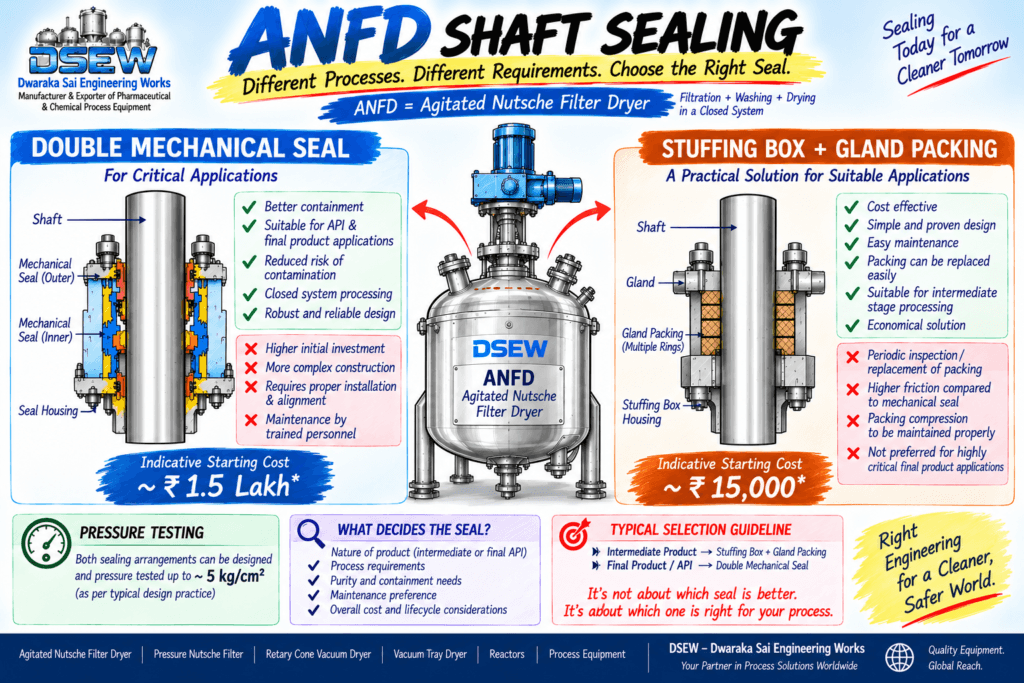
When designing an Agitated Nutsche Filter Dryer (ANFD), one component that deserves careful attention is the shaft sealing arrangement.
The two commonly considered options are:
1. Double Mechanical Seal
2. Stuffing Box with Gland Packing
The right choice is not simply about which seal is “better”.
It depends mainly on the product being processed, process requirements, containment requirements, maintenance philosophy and overall equipment cost.
What is Shaft Sealing in an ANFD?
An ANFD combines filtration, washing and drying in a closed vessel.
During operation, the agitator shaft rotates while the vessel may operate under vacuum or pressure. The shaft sealing arrangement is provided around the rotating shaft to maintain the required separation between the process side and the external environment.
Therefore, selecting the appropriate shaft seal is an important part of ANFD design.
1. Double Mechanical Seal
A Double Mechanical Seal uses two sealing interfaces—an inboard seal on the process side and an outboard seal on the external side.
For critical pharmaceutical and API applications, a double mechanical seal is generally preferred where product containment, purity and controlled sealing are important.
In the Sealwell arrangement used as a reference for ANFD applications, the design includes an inboard and outboard mechanical seal, shaft-protection bellow, barrier-liquid inlet/outlet, seal leak detection port and sterilization provision. The referenced drawing specifies a 40 mm seal size and identifies the equipment as an ANFD handling pharma powder.
Advantages of Double Mechanical Seal
- Better containment
- Suitable for critical API and final-product applications
- Reduced risk of external contamination
- Suitable for closed-system processing
- Robust sealing arrangement
- Better suited to demanding pharmaceutical applications
Considerations
A mechanical seal is a more sophisticated arrangement compared with conventional gland packing.
It generally involves:
- Higher initial investment
- More components
- Proper installation and alignment
- More specialized maintenance
Therefore, the mechanical seal should be selected when the process requirement justifies the additional investment.
2. Stuffing Box & Gland Packing
A Stuffing Box with Gland Packing is a simpler and well-established shaft-sealing arrangement.
The packing rings are installed around the shaft inside the stuffing box and compressed using the gland arrangement.
For intermediate-stage processing, where the application permits a simpler sealing system, stuffing box and gland packing can be a practical and economical choice.
Advantages
- Simple and proven design
- Cost-effective
- Easy maintenance
- Packing can be replaced relatively easily
- Economical for intermediate-stage applications
- Simple construction
Considerations
Gland packing requires proper compression and periodic inspection.
The packing arrangement also has:
- Higher friction compared with a mechanical seal
- Periodic packing inspection/replacement
- Requirement for correct gland compression
- Greater suitability for less-critical applications compared with highly critical final-product applications
This does not mean gland packing is unsuitable for ANFDs.
It means the application should permit its use.
Mechanical Seal vs. Gland Packing — Quick Comparison
| Parameter | Double Mechanical Seal | Stuffing Box + Gland Packing |
|---|---|---|
| Design | More sophisticated | Simple & proven |
| Containment | Better | Application dependent |
| Final API / critical product | Generally preferred | Generally not first choice |
| Intermediate product | Can be used | Practical option |
| Maintenance | More specialized | Simple |
| Initial cost | Higher | Lower |
| Construction | More complex | Simpler |
| Packing replacement | Not applicable | Easy to replace |
| Friction | Lower | Higher |
| Process suitability | Critical applications | Suitable intermediate applications |
What About Pressure Testing?
Pressure testing is another point that often creates confusion.
Both sealing arrangements can be designed and pressure-tested to approximately 5 kg/cm², depending on the actual equipment design, seal arrangement and applicable test requirements.
Therefore, pressure capability alone should not be the deciding factor when selecting the shaft sealing system.
The process requirement is more important.
Cost Difference
There can also be a significant difference in the initial investment.
As an indicative starting point:
Double Mechanical Seal
≈ ₹1.5 Lakh onwards
Stuffing Box + Gland Packing
≈ ₹15,000 onwards
Actual pricing depends on factors such as:
- Shaft size
- Material of construction
- Seal materials
- Seal-face materials
- Design configuration
- Operating conditions
- Application requirements
Therefore, cost should be considered as one selection factor, rather than the only selection criterion.
So, Which One Should You Choose?
There is no universal answer.
A practical selection approach for an ANFD can be:
Intermediate Product
Stuffing Box + Gland Packing can be a practical and economical option where the process permits it.
Final Product / API
Double Mechanical Seal is generally the preferred choice where product purity, containment and sealing reliability are critical.
The important point is that the most expensive sealing arrangement is not automatically the best solution for every application.
Similarly, selecting a lower-cost sealing arrangement simply to reduce equipment cost may not be appropriate for a critical final-product application.
Final Takeaway
When selecting an ANFD shaft sealing arrangement, don’t ask only:
“Which seal is better?”
Ask:
“What product are we processing, and what does the process actually require?”
For the right application, Stuffing Box + Gland Packing can provide a simple and economical solution.
For critical API and final-product applications, a properly selected Double Mechanical Seal can provide a more suitable sealing arrangement.
Good engineering is not about choosing the most expensive option.
It is about choosing the right sealing system for the process.
DSEW – Dwaraka Sai Engineering Works
Manufacturer & Exporter of Pharmaceutical & Chemical Process Equipment
Our Equipment Range:
Agitated Nutsche Filter Dryer | Pressure Nutsche Filter | Rotary Cone Vacuum Dryer | Rotary Vacuum Paddle Dryer | Vacuum Tray Dryer | Reactors | Storage Tanks | Process Equipment