
When designing process equipment for acidic and corrosive applications, material selection becomes one of the most important engineering decisions.
A common approach is to select SS316L for the complete equipment. However, depending on the chemical, concentration, temperature and process conditions, SS316L may not always provide adequate corrosion resistance.
The next option many people consider is:
“Let’s manufacture the complete equipment in Hastelloy.”
While Hastelloy offers excellent corrosion resistance for many demanding applications, manufacturing the entire equipment in Hastelloy can significantly increase the overall project cost.
But is complete Hastelloy construction always necessary?
Not necessarily.
For selected applications, a combination of different materials may provide a more practical and cost-effective solution.
The Challenge: Acidic and Corrosive Process Materials
The suitability of any material depends on several factors, including:
- Type of chemical
- Acid concentration
- Operating temperature
- Pressure or vacuum conditions
- Exposure time
- Mechanical requirements
- Cleaning and process conditions
A material that performs well in one application may not be suitable for another.
Therefore, instead of selecting the same material for every component, it can be beneficial to evaluate the actual function and exposure of each part.
A Smart Material Combination for Agitated Nutsche Filters
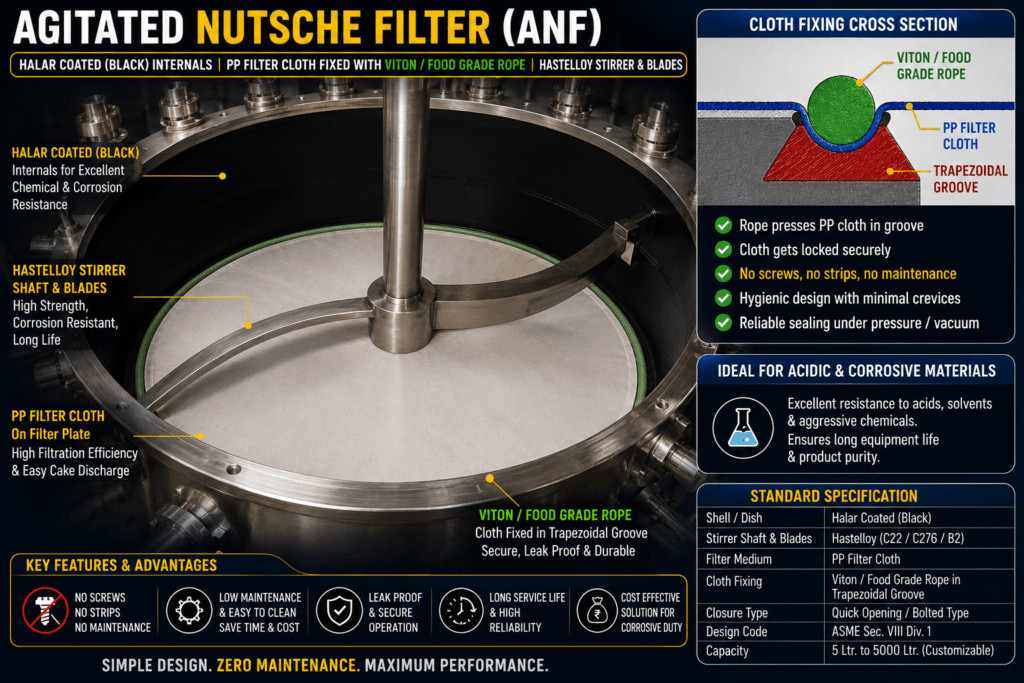
For selected acidic and corrosive applications, an Agitated Nutsche Filter (ANF) can potentially be designed using a combination of different materials.
1. Halar-Coated Shell and Dish
The shell and dish are static product-contact components.
Where chemically compatible, Halar coating can provide a corrosion-resistant barrier over the base material.
This approach may offer an alternative to manufacturing large static components completely from expensive corrosion-resistant alloys.
The internal surface can therefore be protected while helping optimize the overall equipment cost.
2. Hastelloy Stirrer Shaft and Blades
Unlike the shell and dish, the agitator assembly consists of moving components.
The agitator shaft and blades may be exposed to:
- Chemical attack
- Mechanical loads
- Product abrasion
- Continuous movement
For demanding applications, Hastelloy can be considered for the stirrer shaft and blades, depending on the process requirements and chemical compatibility.
Using a high-performance alloy only where required can be a more practical approach than using Hastelloy throughout the entire equipment.
3. PP Filter Cloth
The filtration performance of an ANF depends significantly on the filter medium.
A suitable PP filter cloth can be selected based on:
- Product characteristics
- Particle size
- Filtration requirements
- Chemical compatibility
- Operating conditions
The filter cloth selection should always be based on the actual process.
An Alternative Cloth Fixing Method: Groove and Retaining Rope
One of the interesting design features is the method used for fixing the filter cloth.
Conventional arrangements may use metal fixing strips and multiple screws or fasteners to secure the cloth.
However, an alternative approach is to use a specially designed groove along with a Viton or other suitable food-grade retaining rope, depending on the application.
The concept is simple:
PP Filter Cloth → Positioned over the groove → Retaining rope pressed into the groove → Cloth securely locked in position
The specially designed groove helps retain the rope and prevents it from coming out during operation.
Advantages of a Rope-Based Cloth Fixing System
This design can offer several potential advantages:
No Metal Fixing Strips
The filter cloth does not require conventional metallic strips across the filter plate.
This can result in a cleaner and simpler filter surface.
No Multiple Screws and Fasteners
Reducing the number of screws and fasteners can also reduce potential maintenance points.
Reduced Risk of Corrosion at Fixing Points
In corrosive applications, metallic fasteners can become vulnerable depending on the material and chemical environment.
A properly selected non-metallic retaining system can help eliminate unnecessary exposed metal fixing components.
Simplified Maintenance
Fewer mechanical fixing components can make the filter cloth arrangement simpler to inspect and maintain.
Cleaner and More Hygienic Design
Eliminating unnecessary strips, screws and crevices can help create a cleaner product-contact arrangement.
Can This Be a Cost-Effective Alternative to Complete Hastelloy Construction?
For selected applications, potentially yes.
Instead of manufacturing every component from Hastelloy, the equipment can be evaluated based on the actual service conditions of each component.
For example:
- Static product-contact surfaces: Halar coating, where compatible
- Moving components: Hastelloy, where required
- Filter medium: Suitable PP filter cloth
- Cloth fixing: Viton or other compatible retaining rope in a specially designed groove
This type of hybrid material selection may help optimize the total equipment cost while still addressing corrosion resistance and process requirements.
The objective is not to use the most expensive material everywhere.
The objective is to use the right material in the right location.
Important: Chemical Compatibility Must Always Be Verified
It is important to note that Halar, Hastelloy, PP and Viton are not universally suitable for every chemical application.
The final material selection should always be evaluated based on:
Chemical compatibility | Concentration | Temperature | Pressure/Vacuum | Process conditions
A detailed compatibility and engineering review should be carried out before finalizing the equipment design.
Conclusion
For acidic and corrosive process applications, complete Hastelloy construction may not always be the only available approach.
A carefully designed Agitated Nutsche Filter with Halar-coated static surfaces, Hastelloy moving parts, suitable filter media and a rope-based cloth fixing arrangement may provide a practical and potentially cost-effective solution for selected applications.
The key is not simply choosing the most expensive material.
The key is intelligent material selection based on the actual process requirement.
At Dwaraka Sai Engineering Works, we design and manufacture customized pharmaceutical and chemical process equipment based on specific process requirements.
👉 For more details or to discuss your specific process requirement, feel free to DM us.